



Over the years, I’ve observed bettors dive into markets without ever posing the key question that distinguishes casual enthusiasts from dedicated gamblers. That question is whether the overround works in their favour or quietly drains their bankroll before the first leg even kicks off. Here at Astromania Casino, I wish for you to comprehend exactly what you encounter when you place a bet on the AFL, NRL, or a global cricket test. The overround isn’t some abstract mathematical concept reserved for trading desks in Melbourne’s financial district. It’s the built-in margin that every bookmaker applies to ensure they turn a profit regardless of the outcome. When you see odds for a head-to-head clash between the Sydney Swans and the Brisbane Lions, the implied probabilities of those two prices will always add up to more than one hundred percent. That excess is the overround, and it is the cost you incur for the opportunity to place a wager. I intend to show you exactly how to determine whether that price is equitable, overpriced, or a complete bargain that should be locked in instantly.

Leveraging the Overround to Spot Market Inefficiencies
If the Bookmaker Gets It Wrong
Bookmakers are not flawless, and their overrounds sometimes expose more than they plan to. I’ve observed situations where a bookmaker has clearly copied a competitor’s prices without adjusting for their own liability, resulting in an overround that was suspiciously tight on one outcome and inflated on another. That asymmetry is a flashing neon sign that the market hasn’t attained equilibrium, and it’s where sharp punters can feast. I remember a midweek NRL match where the away team was quoted far too kindly because the bookmaker had overemphasized a single injury report that I knew was deceptive. The overround on the away win was narrow while the home team’s price was carrying almost all of the bookmaker’s margin. I invested on the away side, the team won comfortably, and the bookmaker’s distorted overround was my early warning signal that something was off in their pricing model. You don’t need insider information to spot these opportunities. You just need to determine the implied probabilities, contrast them across a few different bookmakers, and seek the outlier that doesn’t fit the consensus.
Arb Opportunities Right Here at Astromania Casino
I’m not going to claim that arbitrage betting is a sustainable strategy for the average punter, because bookmakers are fast to limit accounts that consistently capitalize on price discrepancies. But there are moments when the overround on a market here at Astromania Casino is so competitive that you can match it with a price at another bookmaker and guarantee a guaranteed profit no matter of the result. These opportunities usually appear in the hours just before a major event when markets are moving rapidly and not every operator is changing at the same speed. I’ve performed arbs on Melbourne Cup day, on AFL grand finals, and on boxing title fights where the combined overround across two bookmakers fell below one hundred percent. That’s the holy grail, and while it’s scarce, it’s absolutely worthwhile watching for. Even if you’re not interested in arbing, understanding the concept helps you to think about betting as a marketplace rather than a lottery. Every bet you place is a transaction, and the overround is the transaction cost. Minimise that cost, and you’ve already gained half the battle before the event even commences.
Comparing Overrounds Throughout Australian Sporting Codes
AFL Betting Markets and the Melbourne Punter’s Advantage
The AFL betting landscape is without a doubt the most competitive in the country, and that competition works directly in your favor when it comes to the overround. With so many bookmakers vying for the attention of footy-mad Victorians, South Australians, and West Australians, the margins on head-to-head markets have been squeezed to levels that were inconceivable a decade ago. I regularly see overrounds on Friday night blockbusters standing at one hundred and two percent, which means the bookmaker is practically charging you a two percent commission on your wager. That’s a steal in any gambling context, and it’s one of the reasons I concentrate a substantial portion of my betting volume on AFL. The line betting markets carry slightly wider margins, typically in the three to four percent range, but even that is acceptable when you consider the complexity of pricing a market where the margin of victory is the variable. Where I see punters get into difficulty is in the exotic markets like first goal scorer or most disposals in a quarter. Those markets are harder for bookmakers to price correctly, so they safeguard themselves with overrounds that can go beyond twenty percent. I treat those as fun bets only, and I never assign serious bankroll to them.
NRL Wagering and the Tight Markets Up North
Rugby league showcases a marginally distinct scenario as the scoring system creates more binary conclusions in the head-to-head market. Draws are uncommon in the NRL relative to soccer, which means the bookmaker only has to price two probable outcomes rather than three. That systemic difference permits tighter overrounds on the win market, and I’ve locked in bets on State of Origin clashes in which the combined implied probability sat at just one hundred and one and a half percent. That’s practically a coin flip with nearly no house edge, and it’s the sort of opportunity that makes me truly excited to place a wager. The handicap markets in NRL carry a bit more fat, typically hovering around four percent, since the bookmaker needs to factor in the likelihood of a push on the line. My advice for anyone wagering NRL regularly is to focus on the head-to-head and keep your handicap exposure controlled. The value is in picking winners, not in striving to nail the exact margin. At Astromania Casino, I’ve developed my NRL strategy around identifying teams that are underrated in the win market and ignoring the noise of the line altogether.
Mental Traps That Cause You to Ignore the Overround
I’ve encountered every psychological trap in the book, and I’m going to be honest about them so you can avoid the same mistakes. The biggest one is the payout illusion, where your brain latches onto the potential return rather than the probability of getting it. A ten-dollar multi that promises a two-thousand-dollar payout looks incredible on the screen, and the dopamine hit you get from envisioning that windfall is powerful enough to overrule any rational assessment of the overround. I’ve learned to differentiate the excitement of the potential win from the cold calculation of whether the bet delivers value. Another trap is the sunk cost mentality that sets in during live betting. You’ve already lost money on a match, so you pursue it by betting more, completely ignoring the fact that the in-play overround has widened and you’re now paying an even higher price for your emotional reaction. The third trap is social proof, where you see everyone at the pub backing the same favourite and you presume the price must be fair. Crowds don’t compute overrounds. Crowds adhere to narratives. Be the person who pulls back, does the maths, and makes a decision based on numbers rather than noise. At Astromania Casino, I want you betting with your head, not over it.
What the Overround Really Signifies for Your Weekend Multi
When I settle in on a Friday evening to build a multi across the weekend’s footy fixtures, I’m not just considering which teams I think will win. I’m determining the cumulative overround that gets embedded into every leg I add. A single head-to-head market might have an overround of around five or six percent at a competitive bookmaker, but the moment you start linking four, five, or six selections into one bet, that margin accumulates in a way that most punters never imagine. Consider you’ve selected five favourites across the AFL round, each offered at one dollar eighty. Individually, those prices appear reasonable, but the multiplicative effect of the bookmaker’s margin means your multi is bearing a theoretical disadvantage that can surpass twenty percent before a ball is even kicked. I’ve seen blokes at the pub throw together eight-leg multis and rejoice like they’ve found the secret, completely oblivious to the fact they’ve offered the bookie a mathematical edge that would turn a casino pit boss blush. At Astromania Casino, I want you to treat every leg as a separate negotiation. Consider whether the single price on offer reflects genuine value or whether you’re just adding filler to pump up a potential payout figure that seems sexy on the screen but has almost no chance of hitting.
Real-Time Betting and the Changing Margin Trap
Why In-Play Overrounds Are a Distinct Beast Entirely
In-play wagering is where the overround becomes a moving target that can either compensate your fast decisions or penalize your impulsiveness. When I’m following a Big Bash League match and the Sydney Sixers drop an early wicket, the in-play odds reset in real time, and the overround often increases substantially during fluctuating moments. The bookmaker’s trading team understands that punters behave impulsively to a fallen wicket or a conceded try, and they expand their margins accordingly to profit on that anxiety. I’ve calculated in-play overrounds during BBL powerplays that swelled to one hundred and twelve percent, which is an utterly harsh tax on your assessment. The key is to pause for the market to stabilize after a significant event rather than diving in while the algorithms are still adapting. A wicket falls, the odds surge, the overround widens, and then over the next thirty seconds it shrinks again as the traders reestablish their position. That thirty-second window is where casual money gets lost and patient punters find edges. At Astromania Casino, our live betting platform offers you the speed you need, but I’m warning you right now that speed without control is just a quicker way to come up short.
Deciphering the Flow to Anticipate Overround Compression
There’s a pattern to live markets that becomes almost musical once you’ve studied enough of them. I’ve noticed that overrounds tend to tighten during periods of continuous pressure when the favourite is controlling possession but hasn’t yet turned that dominance into points. The bookmaker’s model starts valuing in an upcoming score, and the margin on the head-to-head market tightens because the outcome feels progressively predictable. That’s exactly when I like to strike if I’m backing the favourite, because I’m getting a better price with less excess built into the odds. On the other hand, when an underdog is holding on determinedly and the clock is running down, the overround often widens again because the bookmaker wants to deter liability on a result that would damage their book. Understanding this fluctuation transforms live betting from a unpredictable gamble into a organized exercise in pacing. I’ve closed successful positions simply by spotting when the margin had narrowed to a level that no longer offered value and cashing out before the overround expanded again.
Building a Individual Overround Threshold That Protects Your Bankroll
I’ve settled on a personal rule that has served me well through AFL seasons, cricket summers, and everything in between. For any head-to-head bet on a major Australian sport, I refuse to place the wager if the overround surpasses one hundred and five percent. That’s my hard ceiling, and I uphold it ruthlessly. The moment my mental calculation ticks past that number, I abandon the betting slip and advance to the next opportunity. For line betting and handicaps, I allow a little more breathing room and set my cutoff at one hundred and seven percent. Futures and exotics lack a fixed threshold because the variables are too diverse from market to market, but I always compute the number so I know exactly what I’m paying. This discipline has protected me from countless impulsive bets that felt good in the moment but were mathematically bound to lose from the start. I encourage you to set your own thresholds and write them down somewhere you’ll notice them before you open the app. At Astromania Casino betting offers, the platform gives you all the tools you want to make informed decisions, but the discipline has to stem from within. A beautiful interface and competitive odds will not rescue you if you’re ignoring the arithmetic that supports every single market you enter.
Making the Overround Work for You at Astromania Casino
I’ve laid out the system, but the execution is completely in your hands. Each time you enter the sports betting section here at Astromania Casino, you’re stepping into a marketplace where the overround is the silent partner in any deal. Your objective is to make that partner claim as small as possible while you draw as great value as you are able to from the undervalued chances that certainly show up. Start by working out the overround on each and every bet you evaluate, although it’s simply a rapid mental approximation. Over time, you’ll develop an intuition for the things that feels just and that which seems exploitative. Merge that intuition with the attractive odds we offer, and you’ve got a base for wagering that is not built on hope and intuitions. I’ve seen too countless skilled sports experts blow up their bankrolls because they comprehended the games completely but neglected the mathematics of the markets they were playing in. Don’t be that punter. Turn into the person who understands exactly the things that they’re paying, clearly that which they’re getting in return, and precisely the moment to leave. The overround is whether your persistent drag or your preliminary warning setup. The option is yours, and I’m sure you’ll take the right option given that you understand what’s really occurring underneath those prices.
When a Big Overround Is Worth Paying For
I know I’ve spent a lot of time warning you about inflated overrounds, but there are certain cases where I pay a higher margin because the underlying value proposition justifies the extra cost. Futures markets are the typical example. When I bet on the Penrith Panthers to win the premiership at the season’s outset, the overround on the futures book was probably sitting around twenty-five percent across all teams. That seems extreme if you’re considering match betting terms, but futures markets are essentially different beasts. The bookmaker is committing their funds for months, they face injury risk, and they’re evaluating outcomes in a highly unpredictable environment. If I truly think the Panthers have a thirty percent chance to win the competition and I’m receiving odds that suggest a twenty percent chance, I’m unconcerned that the total book holds a hefty margin. I’m obtaining value on my particular pick, and that’s what matters. The same reasoning applies to unusual player props where I possess information or analysis that I think the bookmaker hasn’t completely considered. A large overround on the total market doesn’t automatically negate every single price inside it. Your job is to find the mispriced legs and ignore the ones that are carrying the bookmaker’s water.
How I Spot a Reasonable Overround Prior to the Market Moves
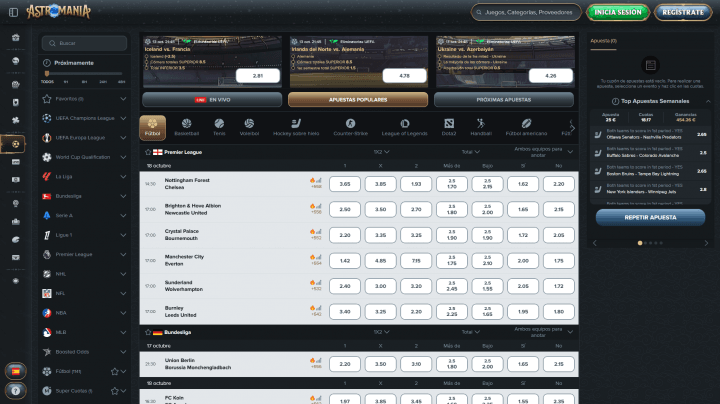
I’ve created a mental checklist that runs in the background every time I open the sports betting interface here at Astromania Casino. The first thing I do is transform the odds for every possible outcome into implied probability percentages and add them together. In a two-horse race like a tennis match between Alex de Minaur and a lower-ranked opponent, a fair overround falls somewhere between one hundred and two and one hundred and five percent. Anything tighter than that and I know the bookmaker is managing a lean operation, possibly even using the match as a loss leader to attract sharp money. When I spot an overround creeping above one hundred and eight percent on a major Australian sporting event, I immediately grow suspicious. That’s the bookmaker showing me they’re not confident in their pricing model, or worse, they’re leveraging casual punters who won’t take the time to check. I also give close attention to the timing of my bets. Markets that launch on a Monday for the following weekend’s NRL round often hold wider overrounds because the bookmaker is protecting themselves against early information asymmetry. By Thursday, when team sheets come out and injury clouds dissipate, those same markets shrink up considerably. I’ve formed a habit of pouncing during that sweet spot when the overround tightens but the public money hasn’t yet arrived to hit the obvious favourites.